

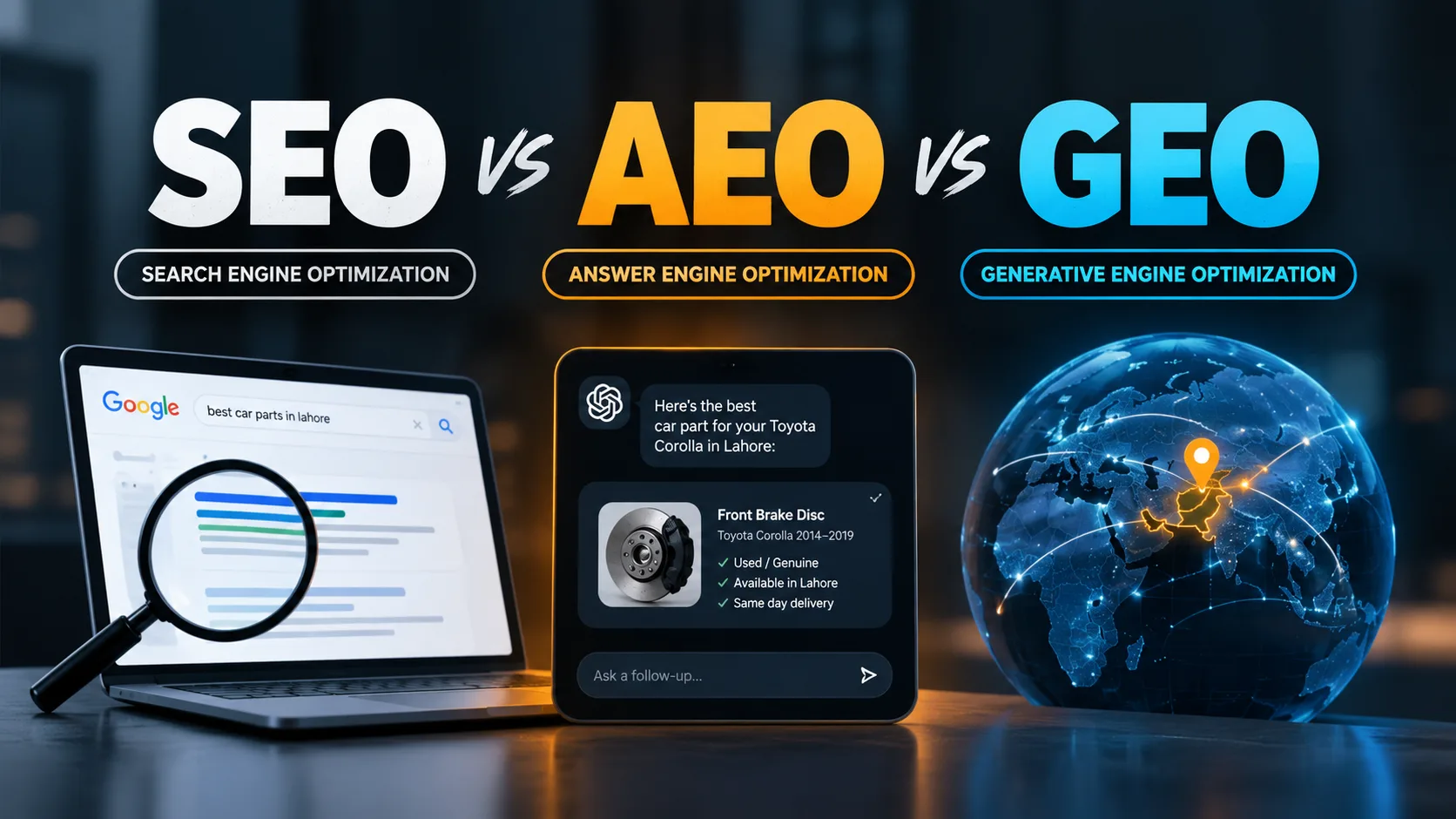
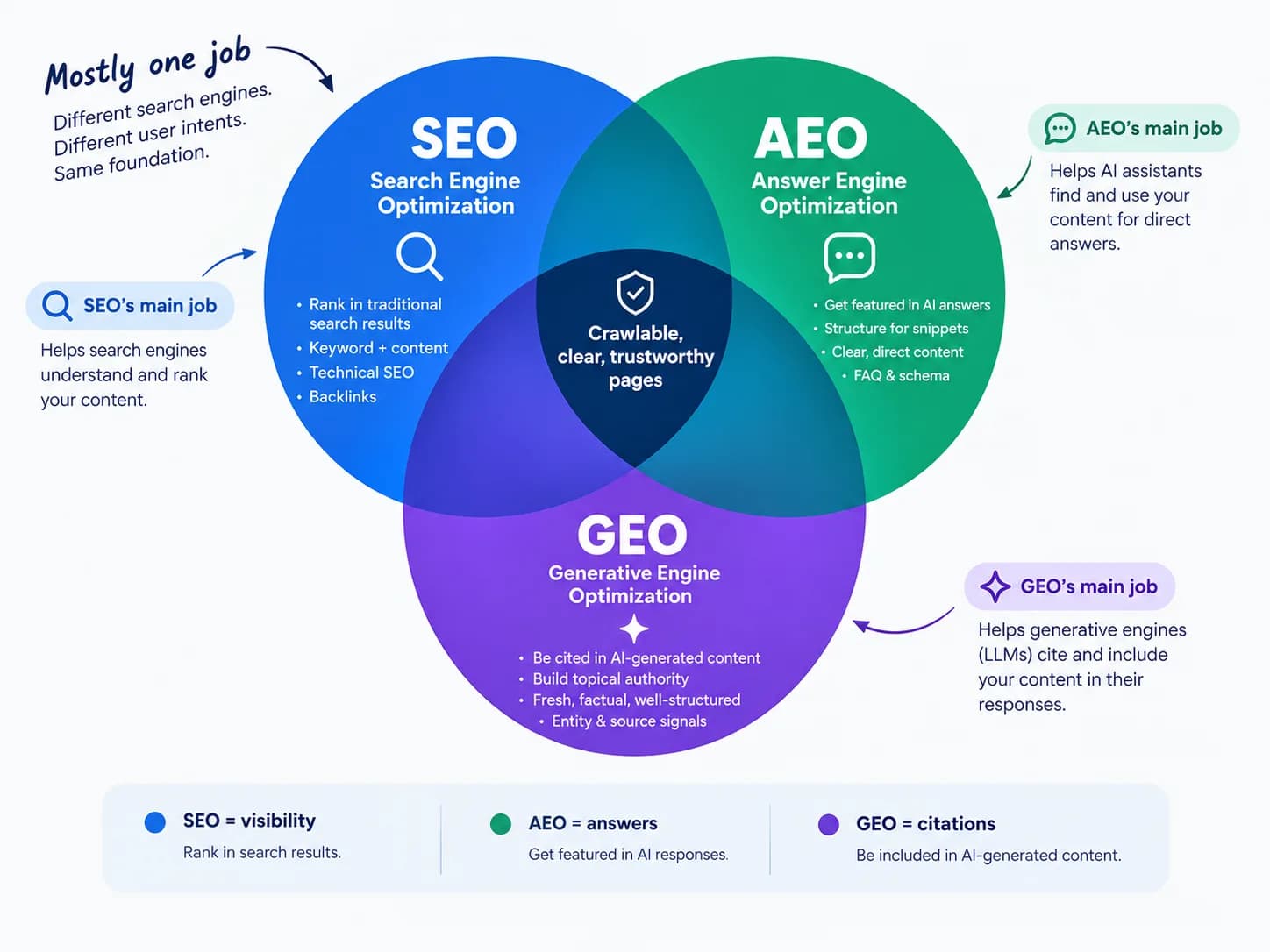
SEO (search engine optimization) is earning a ranked position in a list of search results. AEO (answer engine optimization) is being the source of a direct answer, such as a featured snippet, voice answer or short AI response. GEO (generative engine optimization) is being used or cited in an answer written by an AI system.
They rest on the same foundation, so most of the work counts toward all three. Google describes optimizing for its own AI search features as part of SEO (Google's guidance on AI features and your website). No one can promise you an AI citation, so none of this is a guarantee. It is a map of what is worth your time.
Disclosure: Half Dev makes the free SEO, AEO and GEO checkers linked in this article. They show barriers and gaps. They do not guarantee rankings or citations.
What is the difference between SEO, AEO and GEO?
These terms are young and people use them loosely. Some writers treat AEO and GEO as the same thing, and some treat both as part of SEO. Do not expect a settled definition. What matters is what you do on the page and the site, not the label.
SEO vs AEO vs GEO comparison table
| SEO | AEO | GEO | |
|---|---|---|---|
| Aim | Rank in a list of results | Be the source of a direct answer | Be used or cited in an AI-generated response |
| Where it shows up | A results page | A snippet, voice answer or short AI response | A response written by an AI system |
| What it rewards | Pages that match the search and earn trust | Pages that answer one question early and plainly | Pages an AI system can find, read and rely on |
| Reward | A click | Your content is the answer | A mention or link inside a generated response |
| How you measure it | Rankings, impressions, clicks | Hard to measure fully | Hard to measure fully |
| How settled it is | Decades of tooling and practice | Still emerging | Still emerging |
The last two rows are the honest part. SEO has decades of measurement behind it. AEO and GEO do not, because AI answers vary from one asking to the next and you cannot see exactly where your content was used.
Is GEO just SEO?
Mostly, yes. Take an invented example: a page called "How to reset a home router". One piece of work serves all three labels.
- Open with a plain two-sentence answer. SEO: matches what the searcher wants. AEO: gives a snippet or voice answer something to lift. GEO: gives an AI system a clear passage to use.
- Use sensible headings for each step. SEO: easier to scan. AEO: each question stays separate. GEO: clear structure for a machine reader.
- Keep the page crawlable and indexed. SEO: required to rank. AEO: required to be used as a source. GEO: required to be found at all.
- State facts accurately and name the author. SEO: builds trust. AEO: reduces wrong answers. GEO: gives a system something reliable to draw on.
Four things, done once. Nothing there was a separate project per label. That is why "mostly one job" is the honest summary.
What do SEO, AEO and GEO have in common?
Whichever label you use, the work starts in the same place: a site that can be crawled, pages that answer a specific question early and plainly, accurate facts, sensible headings and clear authorship.
Google's guidance for its AI search features is the same list. Pages must be indexed and crawlable, the content should offer something original, and the technical structure should be clear. If you are weighing where to spend a first hour, spend it here.
Where do SEO, AEO and GEO actually differ?
Two places: measurement and crawler access.
Measurement
SEO has years of tooling: rankings, impressions, clicks. Google offers a Generative AI performance report in Search Console for its own features, announced by Google on June 3, 2026. It covers how often your pages appear in generative AI features in Google Search and Discover, such as AI Overviews and AI Mode. It tells you nothing about other AI products.
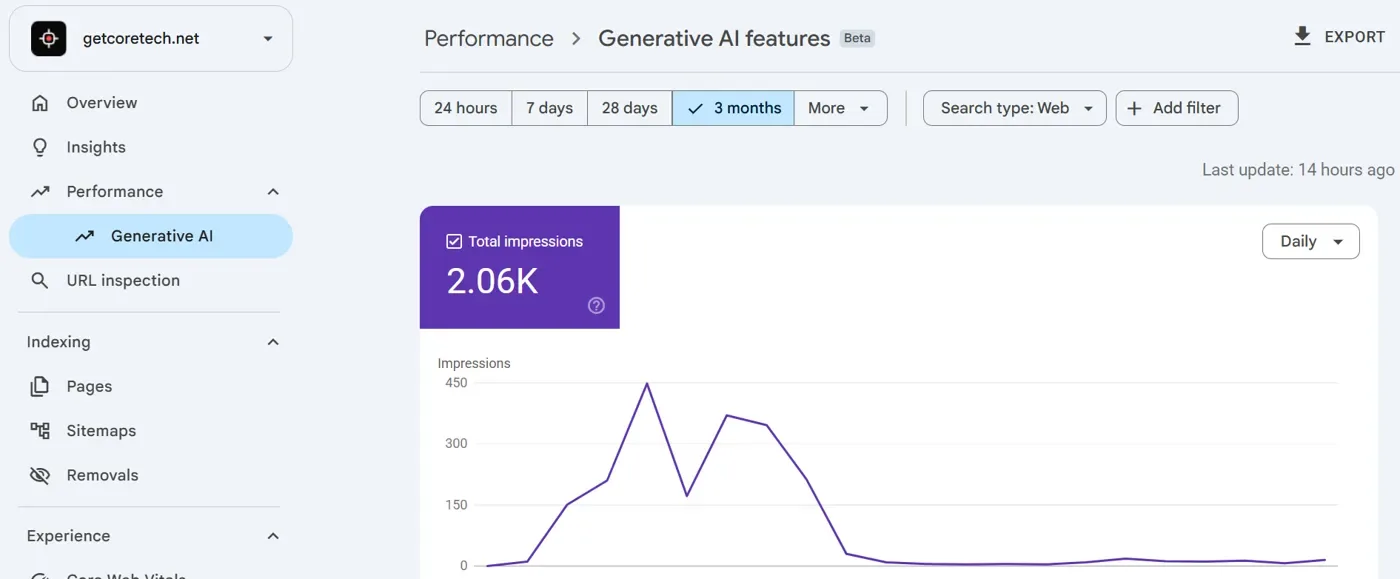
The Generative AI features report in Search Console (Beta), found under Performance. Example from a real site, three months, Web search type.
In Search Console, open Performance and choose Generative AI. At the time of writing the report is labeled Beta. Note the shape of the chart: impressions rise and fall in bursts, a good reminder that AI visibility is uneven and hard to predict.
Google has been rolling the report out in stages, so you may not see it in every account yet. So you can measure part of the picture for Google and little of it elsewhere.
AI crawler access
This is the one place the work is separate rather than shared. AI companies often run different crawlers for different jobs, and each gets its own robots.txt rule. OpenAI, for example, documents GPTBot for training data, OAI-SearchBot for the index behind ChatGPT search, and ChatGPT-User for pages fetched when a person asks ChatGPT to look at something (OpenAI crawler documentation). A rule for one does not cover the others.
# Excerpt from halfdev.com/robots.txt
User-Agent: GPTBot
Allow: /
Disallow: /admin
Disallow: /account
Disallow: /api/
Disallow: /opengraph-image
Disallow: /*/opengraph-image

User-Agent: OAI-SearchBot
Allow: /
Disallow: /admin
Disallow: /account
Disallow: /api/
Disallow: /opengraph-image
Disallow: /*/opengraph-image

User-Agent: ChatGPT-User
Allow: /
Disallow: /admin
Disallow: /account
Disallow: /api/
Disallow: /opengraph-image
Disallow: /*/opengraph-image

# The live file repeats the same rules for other AI crawlers too.
A crawler that matches its own group generally ignores the wildcard group, so the rules are repeated in each.
Opting out of training is therefore not the same as staying out of AI search. A careless wildcard rule can also block crawlers you meant to allow. This is the part of AEO and GEO with a real checklist. Check it on purpose with the free AI crawler checker.
How do I get cited by ChatGPT, Perplexity and AI Overviews?
No tactic guarantees a citation. What helps is the shared foundation: allow the relevant crawlers, keep pages indexable, answer the question in the first lines, state facts accurately and show who wrote it. Then measure what you can, and accept that some of the result is invisible.
What can you skip, according to Google?
Google's guide to its generative AI search features lists tactics it says you can ignore for Google Search: llms.txt files, breaking content into tiny pieces, rewriting content only for AI, seeking fake mentions around the web, and adding special structured data. It says structured data is still worth using for rich results.
This applies to Google's own features. Other AI tools may behave differently and Google does not speak for them, so treat llms.txt and FAQ markup as cheap extras rather than Google requirements. You can test yours with the llms.txt checker. Much of what is sold as separate AI optimization is already part of good SEO or something Google says you do not need. Be wary of any service that sells AEO or GEO as a large new project with special tricks.
Where should you start?
- New site with nothing set up: crawlable pages, clear titles and headings, one question answered per page. Use the SEO audit checklist for a new site.
- Live site you never checked: run all three free checkers once and fix the gaps.
- Documentation or developer content: basics first, then consider llms.txt as a low-cost extra.
- Site that already ranks well: check AI crawler access and make sure your best pages open with a plain answer.
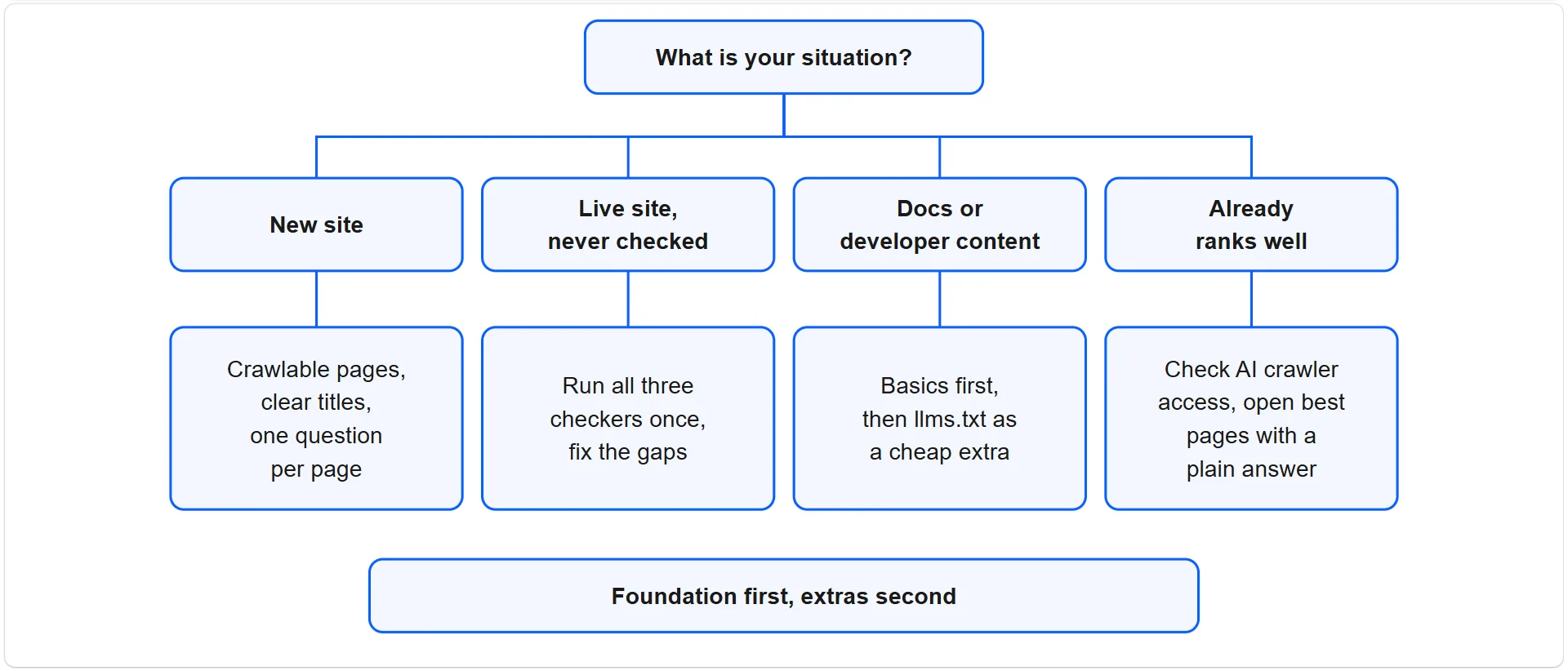
Order is always the same: foundation first, extras second. If you can only do one thing, make your most important pages easy to crawl and quick to answer from.
What are the most common mistakes?
- Treating AEO and GEO as a separate project. Most of the work is good SEO. A second workstream usually duplicates effort.
- Chasing tactics Google says you can ignore. AI-only rewrites and tiny fragments are on Google's list of unnecessary work.
- Blocking too much by accident. A wildcard rule in robots.txt, or a plugin that edits it, can block crawlers you wanted. Name the crawlers you mean to block.
- Expecting a guarantee. A checker shows barriers and gaps. It cannot promise a ranking, snippet or citation, and neither can anyone selling one.
- Measuring only what is easy to measure. A missing number is not a missing result.
So, do you need all three?
You need the shared foundation, and doing it well gets you most of what each label offers. You do not need three separate programs. Check the few things that really are separate: whether AI crawlers can reach your pages, and whether you blocked any on purpose.
How do I check my site?
Run your site through the SEO checker for fundamentals. Use the AEO checker for answer-friendly signals, the AI crawler checker for crawler access, and the GEO checker to look for an llms.txt file (the llms.txt checker tests it in detail) and FAQ structured data. To read the result, see what your Half Dev score means.
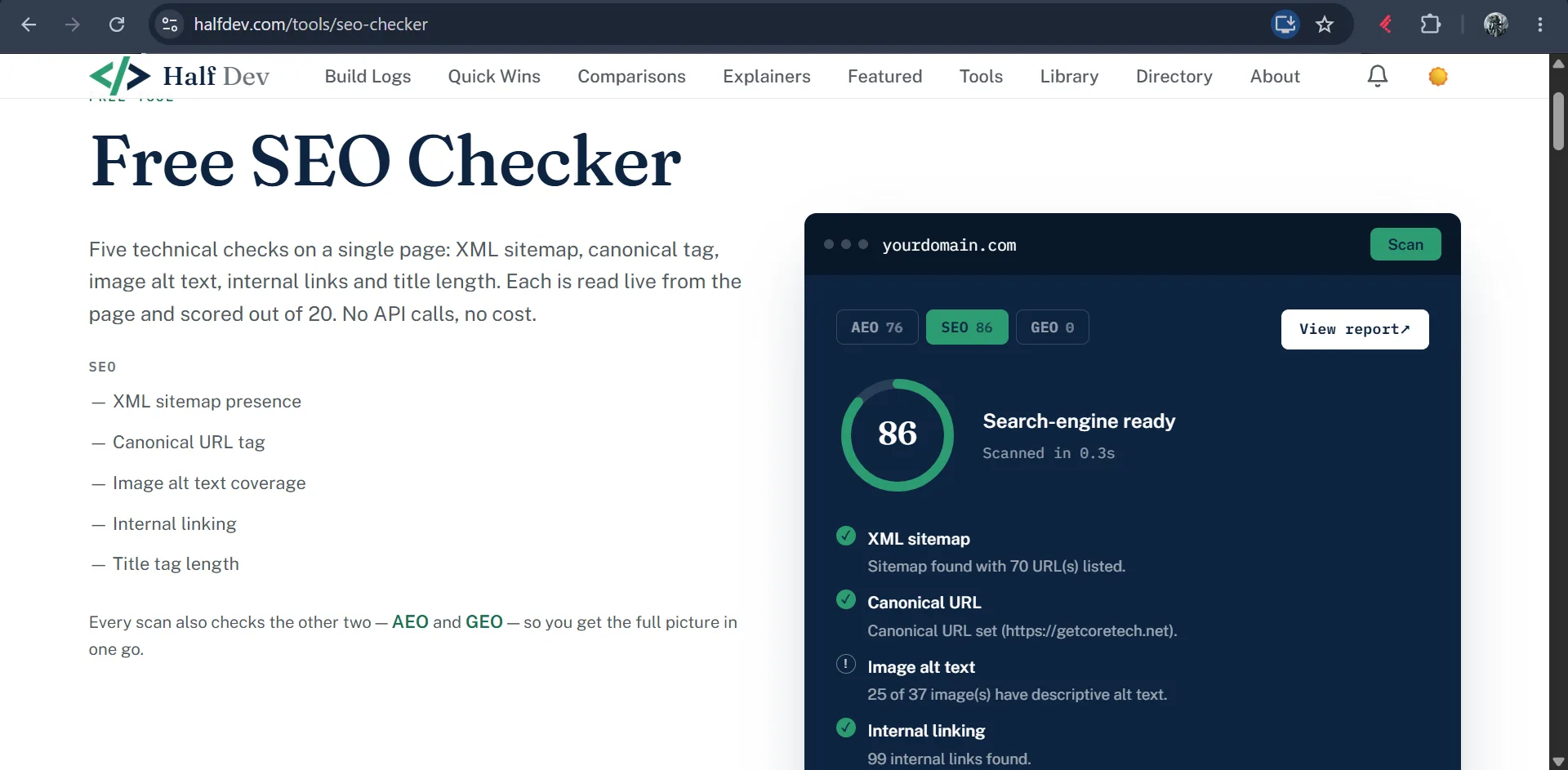
Example scan of a real site with the Half Dev SEO checker.
Comments
No comments yet — be the first.